Introduction
There is no doubt that studying the books of the Old Testament, known as the Tanakh, requires an understanding of the historical and geographical background of these books, as well as knowledge of the ancient Hebrew language (Biblical Hebrew). It also requires familiarity with the interpretations of Jewish rabbis in every era, in order to understand how they perceived these books and how they used them in their liturgies—that is, their communal as well as personal prayers.
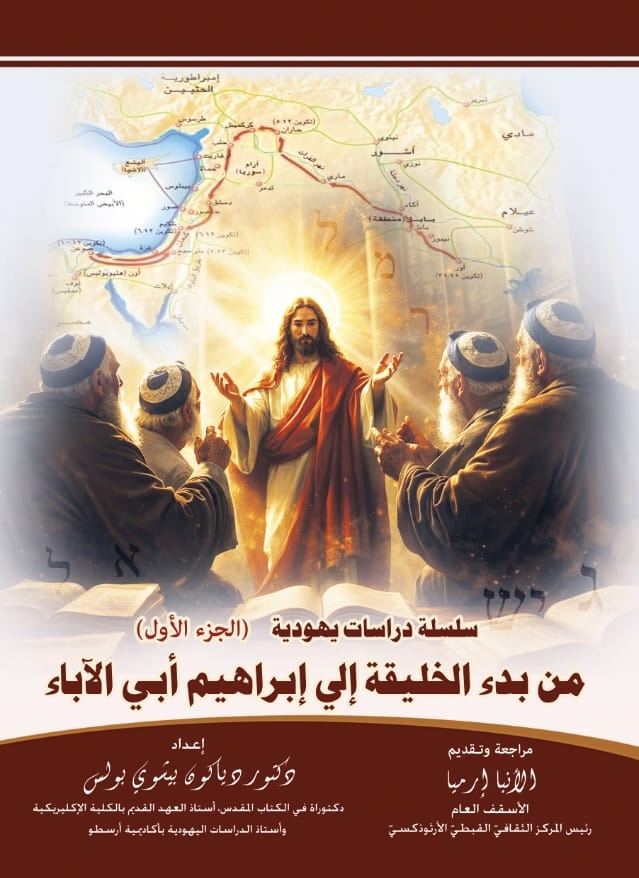
Dear reader, I am pleased to present this book, which constitutes the first part of a series of Jewish studies by Deacon Dr. Bishoy Boulos, entitled “From the Beginning of Creation to Abraham, the Father of the Patriarchs.” In it, Dr. Bishoy reviews the main Jewish traditions, the history of the Jewish people, the geographical locations in which they lived, as well as the fundamentals of the Hebrew language.
In fact, this book marks the beginning of an important series in Jewish studies—one that is much needed in general libraries and particularly in Christian libraries. It is rich in content and highly beneficial, offering every reader the opportunity to gain deeper insight into the books of the Old Testament, as well as the New Testament. This is because the book sheds light on many events in the New Testament that have their roots in the Old Testament and in the interpretations of Jewish rabbis found in their various writings.
In the first chapter, the reader is introduced to several important terms such as: Rabbi, Tanakh, Targum, Mishnah, and Covenant. In the second chapter, we explore certain Jewish customs and traditions, and consider whether the Talmud is beneficial for Christians. We also read about Mitzvah, Halakhah, and Minhag, as well as the differences between the laws of the Torah and rabbinic laws.
In the third chapter, Dr. Bishoy presents an overview of Jewish history, beginning with the very start of creation, including a chronological timeline of the Old Testament. The fourth chapter discusses the geography of the places where the Jewish people lived and the importance of studying this geography.
Finally, in the fifth chapter, the reader is introduced to the Hebrew language—its history and development—along with a discussion of the Semitic languages. Notably, Dr. Bishoy includes the Hebrew alphabet to give readers the opportunity to learn it, as well as a table of key vocabulary with exercises and applications.
All thanks and appreciation go to Deacon Dr. Bishoy for this remarkable effort in producing such a distinguished work. He teaches this series at the Aristotle Academy at the Coptic Orthodox Cultural Center, as well as in theological seminaries.
May the Lord use this series for the glory of His Holy Name, through the blessings of the prayers and intercessions of our holy Mother, the Virgin Mary, and Saint Mark the Apostle, the Evangelist of the Egyptian lands, and through the prayers of His Holiness Pope Pope Tawadros II. To our God be glory, honor, dominion, and worship, now and forever, unto the ages of all ages. Amen.
Anba Ermia
General Bishop
Head of the Coptic Orthodox Cultural Center