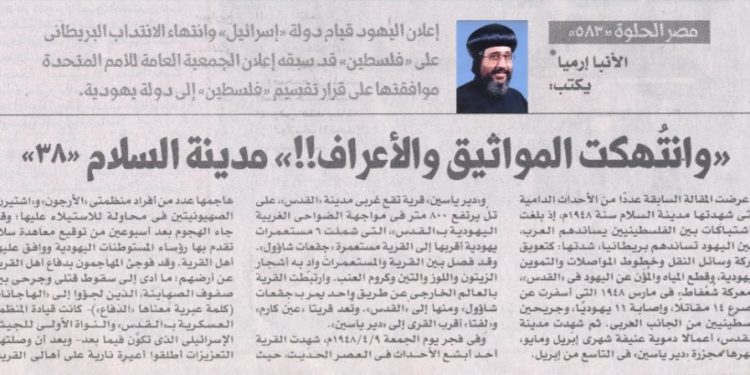
The preceding article detailed a series of brutal events that unfolded in the City of Peace in 1948. Clashes between Palestinians, backed by Arab forces, and Jews, supported by Britain, escalated dramatically. These confrontations involved the disruption of Jewish transportation and supply lines, the cutting off of water and essential supplies to Jewish populations in al-Quds, and the fierce Battle of Shuafat in March 1948, which resulted in the deaths of 14 Jewish fighters and the wounding of 11 Jews and 2 Palestinians. Al-Quds continued to be a scene of intense violence throughout April and May, culminating in the horrific DeirYassin massacre on April 9th.
“DeirYassin” was a Palestinian village situated on an 800-meter-high hill to the west ofal-Quds . It faced the western Jewish suburbs of al-Quds, which encompassed six Jewish settlements, with GivatShaul being the closest. A valley, adorned with olive, almond, fig, and grape vines, separated the village from these settlements. The village’s sole connection to the outside world was a road that passed through GivatShaul and then to al-Quds. The neighboring villages of EinKarem and Lifta are the closest to DeirYassin.
At the dawn of April 9, 1948, the Palestinian village of DeirYassin was the scene of a horrific massacre. Members of the Zionist paramilitary groups Irgun and Lehi (Stern Gang) launched a surprise attack on the village, despite a recently signed peace treaty. The villagers, caught off guard, resisted the attack. After suffering initial casualties, the Zionist forces called for reinforcements from the Haganah “A Jewish word that means defense”, the leadership of the military organization in al-Quds and the precursor to the Israeli Defense Forces. With additional troops, they overwhelmed the village, killing hundreds of men, women, children and elderly people.
According to the Al-Quds website, “The armed Jewish elements did not stop at shedding blood in the village, but took a number of living villagers in cars and paraded them through the streets of the Jewish neighborhoods amid the cheers of the Jews, before returning the victims to the village of ‘DeirYassin’. All international covenants and norms were violated, as the worst forms of torture took place.'”
The death toll is estimated to be between 250 and 360, based on Arab and Palestinian sources.DeirYassin massacre had a profound impact on the Arab-Israeli conflict. It triggered a wave of Palestinian refugees fleeing to neighboring Arab countries and contributed to the formation of the Arab armies that fought in the 1948 Arab-Israeli War.As for the village itself, spanning 27000 Km and home to around 750 people, it was subsequently settled by Jews. In 1980, it was reported that they had rebuilt it on top of the original foundations and named its streets after the Irgun fighters who had carried out the massacre. Thus, al-Quds, the City of Peace, became a stage for bloody events and conflicts.
It is important to note that the Jewish declaration of the establishment of the State of Israel and the end of the British Mandate in Palestine followed the United Nations General Assembly’s approval of a resolution to partition Palestine into a Jewish state (56% of the land), an Arab state (43%), and an internationally administered of al-Quds (1%). This resolution, adopted on November 29, 1947, was welcomed by the Jewish community but rejected by the Palestinians and Arab states.
In response to the UN partition plan, the Arab states formed the Arab Liberation Army to expel the Jewish population from Palestine. Concurrently, the Israeli military general leadership developed “Plan Dalet,” a strategy to counter Arab intervention.
At the stroke of midnight on May 15, 1948, as the British Mandate officially ended, few hours beforehand, the Jewish leadership in Tel Aviv declared the establishment of the State of Israel. This declaration immediately triggered armed conflict between the newly formed Israeli Defense Forces (which included the Haganah) and the Arab Liberation Army, marking the beginning of war. Speaking of al-Quds still takes us aback for stories of “Beautiful Egypt” are endless!
General Bishop
President of the Coptic Orthodox Cultural Center