Arabic
Thursday, June 4, 2026
The Coptic Orthodox Cultural Center
  • About COCC
    • Egypt
      • About COCC
      • Our Goals
      • Our Mission
      • Our Achievments
      • Halls
      • Architectural Design‏
      • Vacancies
      • Donations
      • Security Advisors
      • Managerial Advisor
      • Cultural Advisor
      • Public Relations
      • Ecumenical Relations
      • Information Technology
      • Documentation Management
      • Collectibles Management
      • Marketing Management
      • Legal Management
      • Human Resources
      • Experimental Arts Center
      • Fine Arts Center
      • Center for Strategic Studies & analytical
      • Center for International Cooperation & the Exchange of Cultures
      • Administrative Affairs
      • Center of Studies & Administrative Development
      • Center for International Social Communication
    • U.S.A
    • Germany
    • Australia
  • Head of the Center
    • Center President
    • رئيس المركز الثقافي القبطي الأرثوذكسي
    • اخبار رئيس المركز
    • مقالات
  • Cultural Department
    • الأنشطة
      • كاتب وكتاب
      • مؤتمرات وندوات
      • احتفالات وتكريمات
    • Library
      • انشطة المكتبة اطفال وشباب
      • Children Library
    • COCC Releases
      • كتب
      • مجلة مصر الحلوة
      • نبذات
      • إصدارات المركز CD
    • علاقات مسكونية
    • بيت العائلة المصرية
  • Media Department
    • ME Sat Channel
      • ME Sat Channel Programs
    • أخبار
    • التقرير اليومى
    • أنشطة المركز في الصحف
  • Educational Department
    • Cocc Academy and ME Sat Media Academy
      • Courses for Kids
      • Courses for Adults
        • كللهما بالمجد
    • Scholarships
    • معسكرات خارجية
  • Service Department
    • “Do you Love Me?” Ministry
    • General and religious tourism
  • Awards
    • Wisdom and Compassion “Pope Shenouda III” Award
    • Humanities and Culture “Ola Ghabbour”Award
    • Creativity and Innovation “Makram Mehanna” Award
ادعمنا
No Result
View All Result
  • About COCC
    • Egypt
      • About COCC
      • Our Goals
      • Our Mission
      • Our Achievments
      • Halls
      • Architectural Design‏
      • Vacancies
      • Donations
      • Security Advisors
      • Managerial Advisor
      • Cultural Advisor
      • Public Relations
      • Ecumenical Relations
      • Information Technology
      • Documentation Management
      • Collectibles Management
      • Marketing Management
      • Legal Management
      • Human Resources
      • Experimental Arts Center
      • Fine Arts Center
      • Center for Strategic Studies & analytical
      • Center for International Cooperation & the Exchange of Cultures
      • Administrative Affairs
      • Center of Studies & Administrative Development
      • Center for International Social Communication
    • U.S.A
    • Germany
    • Australia
  • Head of the Center
    • Center President
    • رئيس المركز الثقافي القبطي الأرثوذكسي
    • اخبار رئيس المركز
    • مقالات
  • Cultural Department
    • الأنشطة
      • كاتب وكتاب
      • مؤتمرات وندوات
      • احتفالات وتكريمات
    • Library
      • انشطة المكتبة اطفال وشباب
      • Children Library
    • COCC Releases
      • كتب
      • مجلة مصر الحلوة
      • نبذات
      • إصدارات المركز CD
    • علاقات مسكونية
    • بيت العائلة المصرية
  • Media Department
    • ME Sat Channel
      • ME Sat Channel Programs
    • أخبار
    • التقرير اليومى
    • أنشطة المركز في الصحف
  • Educational Department
    • Cocc Academy and ME Sat Media Academy
      • Courses for Kids
      • Courses for Adults
        • كللهما بالمجد
    • Scholarships
    • معسكرات خارجية
  • Service Department
    • “Do you Love Me?” Ministry
    • General and religious tourism
  • Awards
    • Wisdom and Compassion “Pope Shenouda III” Award
    • Humanities and Culture “Ola Ghabbour”Award
    • Creativity and Innovation “Makram Mehanna” Award
No Result
View All Result
The Coptic Orthodox Cultural Center
No Result
View All Result
Home رئيس المركز Articles Egyptian today

Beautiful Egypt 606 – «The Mamluk Sultanate» – 7/5/2025

by sherine fawzy
25 June 2025
in Egyptian today
Beautiful Egypt 606 – «The Mamluk Sultanate» – 7/5/2025
Share on FacebookShare on Twitter

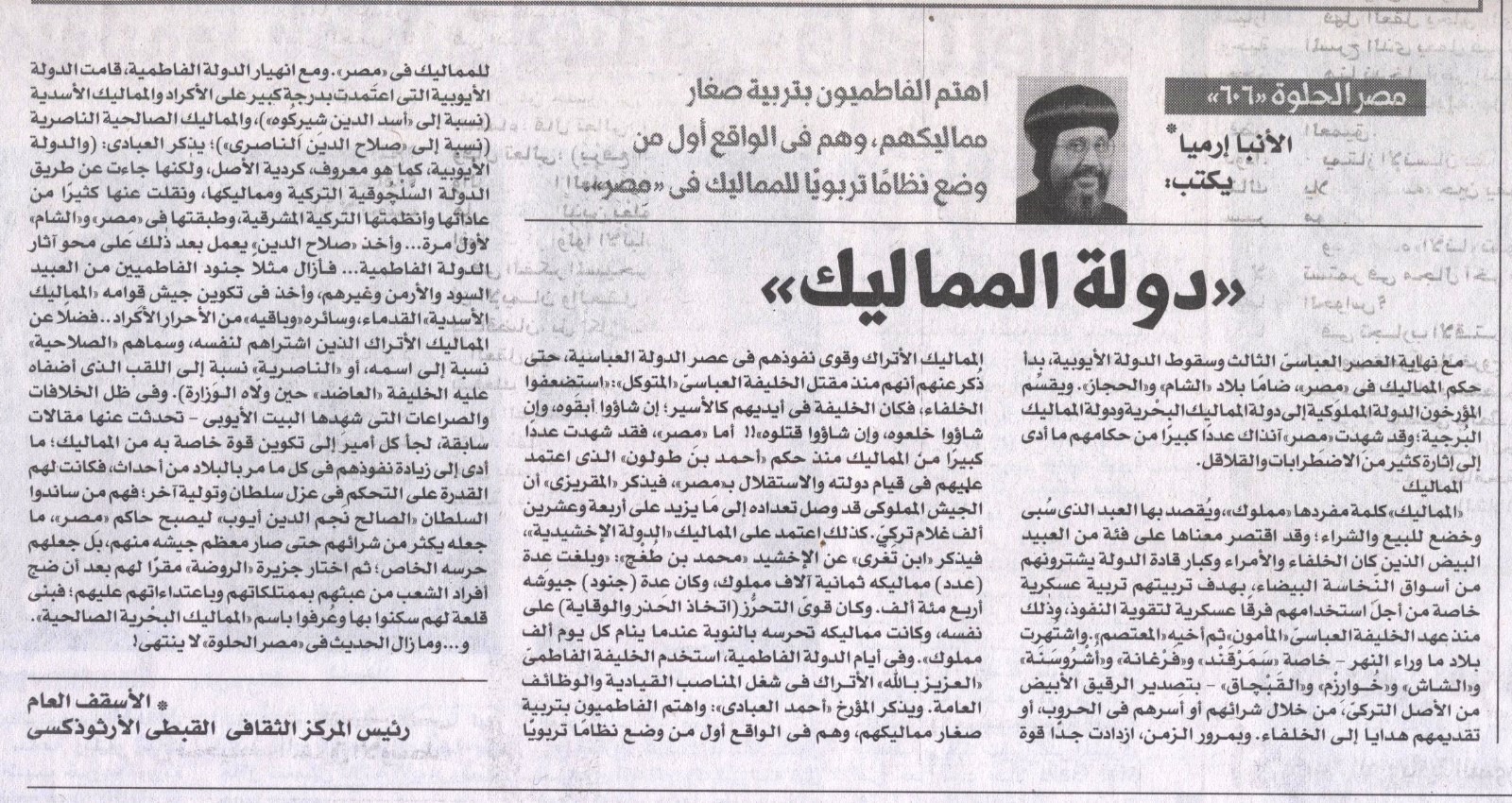
With the end of the Third Abbasid Era and the fall of the AyyubidDynasty, the rule of the Mamluks commenced in Egypt, encompassing the lands of the Levant and the Hejaz. Historians divide the Mamlukdynasty into the Bahri Mamluk Sultanate and the BurjiMamluk Sultanate; Egypt at that time witnessed a large number of their rulers, which led to the stirring of much unrest and turmoil.

The Mamluks

The word “Mamluk” is singular, the plural being “Mamalik”, and it refers to a slave who was captured and subjected to sale and purchase. Its meaning was later restricted to a class of white slaves whom the Caliphs, princes, and senior dynasty leaders would buy from the white slave markets. This was for the purpose of providing them with special military training in order to use them as military units to strengthen their influence, starting from the era of the Abbasid Caliph Al-Ma’mun and then his brother Al-Mu’tasim. The lands beyond the river – particularly Samarkand, Fergana, Ushrusana, Shash, Khwarazm, and the Kipchak – were renowned for exporting white slaves of Turkish origin, through their purchase, capture in wars, or presentation as gifts to the Caliphs.

Over time, the power of the Turkish Mamluks greatly increased, and their influence grew strong during the Abbasid Caliphate. It was even mentioned about them that since the assassination of Al-Mutawakkil, the Abbasid Caliph, they considered all caliphs incapable and even as captives whom they would keep, dispose, or murder as long they deemed necessary.

As for Egypt, it witnessed a large number of Mamluks since the rule of Ahmad ibnTulun, who relied on them in establishing his dynasty and achieving independence in Egypt. Al-Maqrizi mentions that the number of the Mamluk army reached more than twenty-four thousand Turkish youths. Similarly, the Ikhshidid Dynasty relied on the Mamluks, as IbnTaghridynastys about the Ikhshid Muhammad ibnTughj: And the count (number) of his Mamluks reached eight thousand Mamluks, and the count (soldiers) of his armies was four hundred thousand. He was very cautious (taking precautions and protection) for himself, and his Mamluks guarded him in shifts when he slept, with a thousand Mamluks every day.

During the Fatimid Dynasty, the Fatimid Caliph Al-Aziz Billah employed the Turks in occupying leadership positions and public offices. The historian Ahmad al-Abadi mentions: The Fatimid dynasty paid great attention to the upbringing of their young Mamluks, and they were in fact the first to establish an educational system for the Mamluks in Egypt.

With the collapse of the Fatimid Caliphate, the Ayyubid dynasty arose, relying significantly on the Kurds and the Asadi Mamluks (named after Asad al-Din Shirkuh), and the SalihiyyaNasiri Mamluks (named after Saladin al-Nasir).

Al-Abbadi mentions: “The AyyubidDynasty, as is well known, was of Kurdish origin, but it came about through the Turkish Seljuk Dynasty and its Mamluks, from whom it adopted many of its Eastern Turkish customs and systems, applying them in ‘Egypt’ and ‘the Levant’ for the first time… Saladin then began to work on erasing the vestiges of the Fatimid Dynasty… For example, he removed the Fatimid soldiers who were black slaves, Armenians, and others. He began to form an army composed of the old ‘Asadi Mamluks’ and the rest of free Kurds… in addition to the Turkish Mamluks whom he bought for himself, naming them ‘Salihiyya’ after his own name, or ‘Nasiriyya’ after the title bestowed upon him by the Caliph ‘Al-Adid’ when he appointed him as vizier.”

Amidst the disputes and conflicts that the Ayyubid house witnessed – as discussed in previous articles – each prince resorted to forming his own private force of Mamluks. This led to an increase in their influence in all the events that befell the country, so much so that they had the power to control the deposition of one sultan and the appointment of another. They were the ones who supported Sultan As-SalihNajm al-Din Ayyub to become the ruler of Egypt, which made him increase their purchase until most of his army was consisted of them. He even made them his personal guard. He then chose the island of Rawda as their residence after the populace grew weary of their tampering with their properties and their assaults upon them. He built a citadel for them where they resided and became known as Bahri Mamluks “the Salihiyya”.

And stories of Beautiful Egypt are endless

General Bishop

President of the Coptic Orthodox Cultural Center

Previous Post

Beautiful Egypt 605 – «The Fall of the Ayyubid Dynasty» – 30/4/2025

Next Post

Congratulations to His Holiness Pope Leo XIV on His Election as Pope of the Catholic Church

Next Post
Congratulations to His Holiness Pope Leo XIV on His Election as Pope of the Catholic Church

Congratulations to His Holiness Pope Leo XIV on His Election as Pope of the Catholic Church

Please login to join discussion
Facebook Twitter

(العربية)

  • عن مكتبة مارمرقس العامة
  • انشطة مكتبة مارمرقس
  • اخبار مكتبة مارمرقس

Recent Posts

  • The Aristotelian Academy announces the opening of registration for the “Biblical Studies” course
  • Bishop Ermia and the Egyptian Family House congratulate the Governor of Cairo on Eid al-Adha
  • Bishop Ermia the “Do Not Be Afraid” concert at Anba Reweis Theater, with the participation of Bishop Sarabamon and Bishop Elia

© 2022 المركزأالثقافي القبطى الارثوذكسي

No Result
View All Result
  • About COCC
    • Egypt
      • About COCC
      • Our Goals
      • Our Mission
      • Our Achievments
      • Halls
      • Architectural Design‏
      • Vacancies
      • Donations
      • Security Advisors
      • Managerial Advisor
      • Cultural Advisor
      • Public Relations
      • Ecumenical Relations
      • Information Technology
      • Documentation Management
      • Collectibles Management
      • Marketing Management
      • Legal Management
      • Human Resources
      • Experimental Arts Center
      • Fine Arts Center
      • Center for Strategic Studies & analytical
      • Center for International Cooperation & the Exchange of Cultures
      • Administrative Affairs
      • Center of Studies & Administrative Development
      • Center for International Social Communication
    • U.S.A
    • Germany
    • Australia
  • Head of the Center
    • Center President
    • رئيس المركز الثقافي القبطي الأرثوذكسي
    • اخبار رئيس المركز
    • مقالات
  • Cultural Department
    • الأنشطة
      • كاتب وكتاب
      • مؤتمرات وندوات
      • احتفالات وتكريمات
    • Library
      • انشطة المكتبة اطفال وشباب
      • Children Library
    • COCC Releases
      • كتب
      • مجلة مصر الحلوة
      • نبذات
      • إصدارات المركز CD
    • علاقات مسكونية
    • بيت العائلة المصرية
  • Media Department
    • ME Sat Channel
      • ME Sat Channel Programs
    • أخبار
    • التقرير اليومى
    • أنشطة المركز في الصحف
  • Educational Department
    • Cocc Academy and ME Sat Media Academy
      • Courses for Kids
      • Courses for Adults
    • Scholarships
    • معسكرات خارجية
  • Service Department
    • “Do you Love Me?” Ministry
    • General and religious tourism
  • Awards
    • Wisdom and Compassion “Pope Shenouda III” Award
    • Humanities and Culture “Ola Ghabbour”Award
    • Creativity and Innovation “Makram Mehanna” Award

© 2022 المركزأالثقافي القبطى الارثوذكسي